• Eli Lilly & Co. v. Teva Parenteral Medicines , No. 2011-1561 (Fed. Cir.)

        by Aaron F. Barkoff

    Lilly's anticancer drug Alimta (pemetrexed) is approved for the treatment of mesothelioma and non-small cell lung cancer.  Teva, Barr and APP filed ANDAs seeking approval to market generic versions of Alimta prior to the expiration of U.S. Patent No. 5,344,932, owned by Princeton University and exclusively licensed to Lilly.

    In a unanimous opinion last Friday, the Federal Circuit affirmed a district court decision that the asserted claims of the '932 patent are not invalid for obviousness-type double patenting.

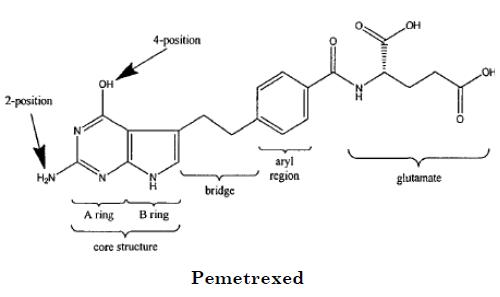
    Claim 3 of the '932 patent recites pemetrexed:

    Pemetrexed
    Teva asserted that claim 3 of the '932 patent is invalid for obviousness-type double patenting over two patents in the same family as the '932:  U.S. Patent Nos. 5,028,608 and 5,248,775.  The '608 and '775 patents have expired, but the '932 patent remains in effect until July 24, 2016, due to a patent term extension of over four years to compensate for delays in the regulatory approval of Alimta.  Lilly holds a further six months of pediatric exclusivity over pemetrexed.

    As the Federal Circuit explained:

    The doctrine of obviousness-type double patenting is intended to prevent the extension of the term of a patent by prohibiting the issuance of claims in a second patent not patentably distinct from the claims of the first patent.  A later patent claim is not patentably distinct from an earlier claim if the later claim is obvious over, or anticipated by, the earlier claim.

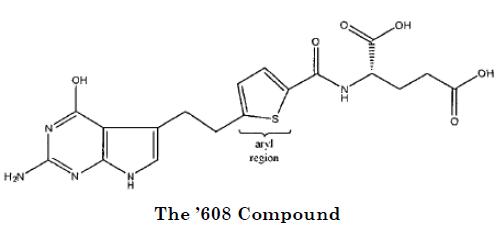
    Teva's first argument was that pemetrexed is not patentably distinct from a compound recited in claim 3 of the '608 patent:

    '608 Compound

    Here, according to the Federal Circuit:

    Teva's primary argument concerns the appropriate legal standard for evaluating obviousness-type double patenting.  Relying on our decision in Amgen Inc. v. Hoffman La-Roche Ltd., 580 F.3d 1340 (Fed. Cir. 2009), Teva contends that the correct analysis involves only the differences between the claims at issue, so that any features held in common between the claims–in this case, all but the aryl regions of the '608 Compound and pemetrexed–would be excluded from consideration.  In Amgen, we explained that once the differences between claims are established, the obviousness-type double patenting analysis entails determining "whether the differences in subject matter between the claims render the claims patentably distinct."  But those differences cannot be considered in isolation–the claims must be considered as a whole.

    On the merits, the court stated:

    In the chemical context, we have held that an analysis of obviousness-type double patenting requires identifying some reason that would have led a chemist to modify the earlier compound to make the later compound with a reasonable expectation of success.  Here, the district court considered the parties' arguments and evidence, particularly their conflicting expert testimony as to how an ordinarily skilled chemist presented with the '608 Compound would have been motivated to proceed at the time.  In its decision, the court credited Lilly's evidence to find that "the ways in which a person of ordinary skill in the art would modify [the '608 Compound] would not result in pemetrexed."  We owe that finding considerable deference on appeal, and we see no clear error based on the record before us.

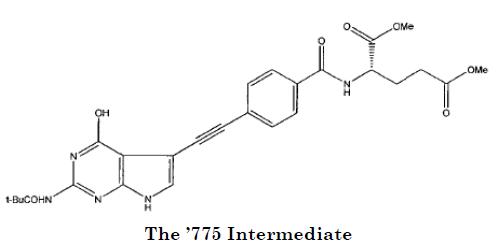
    Teva's second argument was that pemetrexed is not patentably distinct from a compound recited in claim 2 of the '775 patent:

    '775 Intermediate
    Here, Teva's arguments were based not on the structural similarity of pemetrexed and the '775 Intermediate, but rather on the fact that the '775 patent disclosed that the '775 Intermediate is used to make pemetrexed.  As the court put it, "By later claiming pemetrexed itself, Teva maintains, the '932 patent appropriates a previously disclosed use for previously patented compound, which renders the asserted '932 claims invalid for obviousness-type double patenting under a line of our precedent including . . . Sun Pharm. Indus. v. Eli Lilly & Co. (Fed. Cir. 2010)."

    The Federal Circuit explained:

    As a general rule, obviousness-type double patenting determinations turn on a comparison between a patentee's earlier and later claims, with the earlier patent's written description considered only to the extent necessary to construe its claims.  . . .  The cases on which Teva relies represent a limited exception to this customary framework.  . . .  In Pfizer v. Teva Pharms. USA (Fed. Cir. 2008), we held claims to methods of administering a particular anti-inflammatory drug invalid for obviousness-type double pateting where th patentee's earlier patent claimed the drug itself and disclosed the same methods of administering the drug.  And in Sun, the patent holder had developed an antiviral compound, gemcitabine, that also proved useful for treating cancer.  . . .  As in Pfizer, we held the patentee's subsequent claims to methods of using gemcitabine to treat cancer invalid for double pateting, looking to the disclosure of anticancer utility in the first patent's specification.

    In summary, according to the court, Pfizer and Sun "address the situation in which an earlier patent claims a compound, disclosing the utility of that compound in the specification, and a later patent claims a method of using that compound for a particular use described in the specification of the earlier patent.  Furthermore, in each of those cases, the claims held to be patentably indistinct had in common the same compound or composition."

    The court distinguished this case:

    Rather than a composition and a previously disclosed use, the claims at issue recite two separate and distinct chemical compounds:  the '775 Intermediate and pemetrexed, differing from each other in four respects.  That alone suffices to undermine Teva's argument regarding the '775 Intermediate, for the asserted claims of the '932 patent do not recite a use of the same compound, but a different compound altogether.

    Finally, the Federal Circuit corrected an error made by the district court.  The district court disregarded Lilly's objective evidence of nonobviousness, holding that "secondary considerations are not relevant to the analysis of invalidity for obviousness-type double patenting."  The Federal Circuit took the opportunity to reiterate its recent statement from In re Cyclobenzaprine:  a fact-finder "must withhold judgment on an obviousness challenge until it has considered all relevant evidence, including that relating to the objective considerations."

  • Momenta Pharms. v. Amphastar Pharms., No. 2012-1062 (Fed. Cir.)

        by Aaron F. Barkoff

    Last year, in Classen v. Biogen IDEC, a three-judge panel of the Federal Circuit held that the safe harbor of Section 271(e)(1) "does not apply to information that may be routinely reported to the FDA, long after marketing approval has been obtained."  The majority opinion was written by Judge Newman, with Chief Judge Rader concurring and providing additional views, and Judge Moore dissenting.  A petition for certiorari in the case is currently pending at the Supreme Court, and the Court recently asked the Solicitor General's office to weigh in with its views.

    Last Friday, in Momenta v. Amphastar, a case between two manufacturers of generic Lovenox (enoxaparin), a slightly different three-judge panel of the Federal Circuit held that the safe harbor does apply to certain post-approval activities.  In the case, Judge Moore wrote the majority opinion, joined by Judge Dyk, and Chief Judge Rader wrote a blistering 29-page dissent.  The decisions in the two cases do not seem entirely consistent with each other, which likely raises the odds that the Supreme Court will agree to hear the Classen case.

    Momenta is the assignee of U.S. Patent No. 7,575,886, which generally relates "to methods for analyzing heterogeneous populations of sulfated polysaccharides, e.g. heparin [and] . . . LMWH [low molecular weight heparin–e.g., enoxaparin]."  Two days after Amphastar received final FDA approval to market its generic enoxaparin (and more than a year after Momenta received its own approval), Momenta filed suit against Amphastar, accusing Amphastar of "manufacturing generic enoxaparin for commercial sale" and performing "in their process for manufacturing batches of enoxaparin" an analytical method that infringes the '886 patent.  According to the majority opinion, Momenta also alleged that this infringing testing was necessary to "satisfy the FDA's requirements."

    The district court granted Momenta a preliminary injunction, concluding that Amphastar's testing falls outside the scope of the safe harbor under Section 271(e)(1):  "although the safe harbor provision permits otherwise infringing activity that is conducted to obtain regulatory approval of a product, it does not permit a generic manufacturer to continue in that otherwise infringing activity after obtaining approval."  Amphastar appealed, contending that the district court adopted an overly restrictive view of the safe harbor.

    The Federal Circuit majority opinion began by addressing Momenta's "contention that the information in question was not 'submitted' to the FDA, but rather was retained by the ANDA holder."  Here, the majority concluded that "the fact that the FDA does not in most cases actually inspect [Amphastar's manufacturing test records] does not change the fact that they are for the development and submission of information under a Federal law."  The majority cited the Supreme Court's Merck v. Integra decision for "holding that uses which are not ultimately included in a submission to the FDA are nonetheless exempted by the safe harbor."

    The majority then turned to whether Amphastar's submissions are protected by the safe harbor.  Here, the majority took pains to distinguish Classen:

    At issue in Classen were [post-marketing] studies to evaluate the association between the timing of childhood vaccinations and the risk of developing certain immune-mediated disorders.  The studies themselves were not mandated by the FDA, but any vaccine license holder was required to report to the FDA "adverse experience information," such as adverse side effects, it acquired as a result of vaccine studies.  We found that the studies conducted by the vaccine license holder according to patented methods were not insulated by the safe harbor because the studies did not facilitate marketing a generic drug by "expediting development of information for regulatory approval."  We, of course, are bound by the Classen decision unless it is overruled en banc or by the Supreme Court.  Accordingly, the scope of the safe harbor provision does not extend to "information that may be routinely reported to the FDA, long after marketing approval has been obtained."

    This case, however, fits well within Classen because the information submitted is necessary both to the continued approval of the ANDA and to the ability to market the generic drug.  Here, the submissions are not "routine submissions" to the FDA, but instead are submissions that are required to maintain FDA approval.  . . .  Failure to comply with these requirements could result in suspension or revocation of Amphastar's ANDA approval to market the drug.

    We also note that, unlike in Classen where the patented studies performed were not mandated by the FDA, the information here is not generated voluntarily by the manufacturer but is generated by FDA requirements the manufacturer is obligated under penalty of law to follow.  Under such circumstances, the information can be said to have been gathered solely for submission to the FDA and not, as in Classen, primarily for non-FDA purposes.  While Momenta urges us to adopt the pre-/post-approval distinction used by the district court, we cannot:  Classen did not turn on this artificial distinction, and the plain language of the statute is not restricted to pre-approval activities.

    Unlike Classen, where the allegedly infringing activity "may" have eventually led to an FDA submission, there is no dispute in this case that Amphastar's allegedly infringing activities are carried out to "satisfy the FDA's requirements."

    In a strongly-worded dissent, Chief Judge Rader repeatedly refers to Amphastar as a "trespasser" and "infringer."  He traces the legislative history of Section 271(e)(1)–which is curious given that the Supreme Court has twice minimized the legislative history and based its decisions instead on the plain (and broad) language of the statute.  And he takes great exception to the majority opinion's basis for distinguishing Classen.  Finally, he claims that the majority's "interpretation of 271(e)(1) would essentially render manufacturing method patents worthless."  While this is an exaggeration, the Supreme Court might reply:  "that is a problem for Congress to fix, if they so choose."

    Where the scope of the 271(e)(1) safe harbor ends up matters a great deal, particularly as we approach the era of biosimilar patent litigation.  Like enoxaparin, biologics are complex molecules and thus analytical-method patents figure to be in the patent portfolios protecting them.  The sooner the courts can agree on the scope of the safe harbor, the better for everyone.

  • FDA has been busy preparing for the day when the first biosimilar application is filed.  In February, FDA published three draft guidance documents on biosimilars.  In May, FDA held a public hearing on the guidance.  And earlier this week, FDA announced biosimilar user fee rates for fiscal year 2013.

    Patent lawyers have been busy preparing too.  On September 11th, I will be speaking on "Best Practices in Portfolio Management During the Patent Exchange Process" at IIR USA's 13th Annual Business of Biosimilars & Generic Drugs conference, to be held in Boston from September 10-12.  According to the conference producer:

    Initially established in 1999 as "The Generic Drugs Summit," this event from the outset helped shape best practice and performance standards in the generics industry.  In early years, a major topic of discussion was the potential for "biogenerics," with the biotech industry hoping that these molecules could be created and approved through long-tested and familiar methods.  When it became clear that a radically different pathway would be required, we became the first commercial event to address the regulatory and commercialization concerns relevant to follow-on biologics, under our new banner, "The Business of Biosimilars and Biobetters."  Now building off the accumulated expertise of our long history, we are proud to offer "The Business of Biosimilars and Generic Drugs" in order to illuminate the most urgent and timely topics relevant to follow-on biopharmaceuticals.  This year's program features crossover topics of interest to both groups, as well as breakout sessions to give equal time when their needs diverge.

    Here is the complete agenda:

    September 10

    • Morning Summit:  Biosimilar R&D Scenario Planning Session
    • Afternoon Summit:  choose from "Map the Strengths, Weaknesses, and Defenses of your IP Assets to Prepare for the Challenges of the Follow-On Process" or "Assessing the Immunogenicity Potential for Biosimilars"

    September 11–Morning

    • Think Different–Navigating the Brave New Globalized Life Science Industry
    • The World is Flat–Make Sure Your Sales Are Not–Commercializing Generics in Global and Emerging Markets
    • The New Paradigm in Strategic Partnerships for Follow-On Biopharmaceutical Development
    • Reimbursement Strategies for Generics and Biosimilars Around the World

    September 11–Afternoon

    Track 1:  Market Access for Biosimilars

    • The Strategy and Case Study of Global Biosimilar Development
    • Overview of Biosimilar Trends in BRIC Countries
    • The Future of Biosimilars in Specific Emerging Markets
    • Combat Misinformation About Biosimilars

    Track 2:  Market Access for Generics

    • Preparing Global Manufacturing Processes for Product Rollouts
    • Direct-to-Pharmacy and Direct-to-Consumer Rebate Strategies:  What's Coming Next?
    • Analyzing the Regulatory Criteria That Your Generic Drug Candidate Must Meet
    • Establishing R&D Methods and Timetables That Will Streamline Your Expansion to New Markets

    Track 3:  Legal/IP for Biosimlars

    • Turn Antitrust Laws to Your Advantage in the Generics and Biosimilars Marketplace
    • Best Practices in Portfolio Management During the Patent Exchange Process
    • Experiences from Developing Biosimilars for EMA:  Unique Perspectives from Growth Hormones to Monoclonal Antibodies
    • Adapt to New Regulatory Requirements for Biosimilar Approval and Success

    September 12

    • Outlook and Strategic Impact of the U.S. Biosimilar Approval Pathway
    • Regulatory Extrapolation of Therapeutic Indications for Complex Biosimilars:  Clinical and Regulatory Updates, and Ways to Proceed
    • Improve and Approve:  Boost the Safety and Convenience of Biobetters, and Navigate the New Regulatory Environment
    • Building Product Awareness and Acceptance:  What Can Biosimilars and Generics Learn from One Another?
    • When Being the Same is Good Enough:  Building Public Confidence and Interest in Biosimilars
    • Preparing for IP Challenges:  What Originators and Follow-On Companies Need to Know

    For more information or to register, please visit the conference website.  To save 25%, register using promotion code XP1786OBB.

    • On Friday morning, the USPTO pre-published its proposed rule changes implementing the provisions of the America Invents Act that convert the U.S. patent system from a "first to invent" to a "first inventor to file" system.  The proposed rules (available here) were scheduled to be published in the Federal Register on Monday, but were withdrawn later Friday.  We understand that the proposed rules were withdrawn because there was not enough space in Monday's Federal Register to accomodate both the proposed rules and a companion "guidance document" that the PTO wants published in the same issue of the Federal Register.  We expect that the proposed rules and guidance document will be published together sometime next week, and further that the published proposed rules will be identical to those that were pre-published today.
    • Also Friday morning, the Federal Circuit heard oral argument in AMP v. Myriad following remand from the Supreme Court for further consideration in light of Prometheus.  An .mp3 audio recording of the oral argument is available here and also posted on the Federal Circuit's website.
    • On Thursday, Judge Sleet of the U.S. District Court for the District of Delaware issued a 133-page opinion holding Pfizer's patents on Lyrica (pregabilin) valid and infringed by eight generic drug companies who filed ANDAs with paragraph IV certifications to the patents.  The ANDA applicants are now enjoined from marketing their generic versions of Lyrica until at least December 30, 2018, when, according to the Orange Book, the last of the patents-in-suit will expire.  The issues in the case included obviousness, anticipation, priority, written description, inventorship, literal and DOE infringement, and finally whether two patent term extensions, stemming from two separate NDAs for Lyrica that were approved on the same day, were valid.
  • In Re: K-Dur Antitrust Litigation, No. 10-2077 (3d Cir.)

    In what antitrust experts are calling a "landmark" decision, the Third Circuit Court of Appeals on Monday held that so-called "pay-for-delay" or "reverse payment" settlement agreements are presumptively anticompetitive and illegal.  In 2005, the Eleventh Circuit Court of Appeals, analyzing the same settlement agreements at issue here, but applying a different test, reached essentially the opposite result.  Because of the circuit split, many observers believe that with this case, the Supreme Court will finally address the legality of reverse payment settlements.

    The two settlement agreements at issue in the case involve Schering's blood pressure drug K-Dur 20.  In 1997, Schering and Upsher-Smith settled their paragraph IV case on terms that included a $60 million payment from Schering to Upsher and an agreement by Upsher not to market its generic version of K-Dur until 2001.  At about the same time, Schering and ESI Lederle settled their paragraph IV case on terms that included a $10 million payment from Schering to ESI and an agreement by ESI not to market its generic K-Dur until 2004.

    The Third Circuit's opinion provides a concise history of court decisions examining reverse payment settlements under the antitrust laws.  Since 2001, five other circuit courts have addressed the legality of reverse payment settlements.  The D.C. Circuit in 2001 and the Sixth Circuit in 2003 both concluded that such agreements should be subject to strict antitrust scrutiny, at least where the parties attempted to "park" the first ANDA filer's 180-day exclusivity period in order to block subsequent ANDA filers.  The Eleventh Circuit in 2003 and 2005, the Second Circuit in 2006, and the Federal Circuit in 2008 each applied the "scope of the patent" test, under which "the essence of the inquiry is whether the agreements restrict competition beyond the exclusionary zone of the patent."  More specifically, under the scope-of-the-patent test, "reverse payments are permitted so long as (1) the exclusion does not exceed the patent's scope, (2) the patent holder's claim of infringement was not objectively baseless, and (3) the patent was not procured by fraud on the PTO."

    The Third Circuit rejected the scope-of-the-patent test here, stating:  "As a practical matter, the scope of the patent test does not subject reverse payment agreements to any antitrust scrutiny.  As the antitrust defendants concede, no court applying the scope of the patent test has ever permitted a reverse payment antitrust case to go to trial."  According to the court, the "test improperly restricts the application of antitrust law and is contrary to the policies underlying the Hatch-Waxman Act and a long line of Supreme Court precedent on patent litigation and competition."

    The court further explained:

    In rejecting the scope of the patent test, we are cognizant that such a test encourages settlement, an objective our decisions generally support.  However, the judicial preference for settlement, while generally laudable, should not displace countervailing policy objectives or, in this case, Congress's determination–which is evident from the structure of the Hatch-Waxman Act and the statements in the legislative record–that litigated patent challenges are necessary to protect consumers from unjustified monopolies by name brand drug manufacturers.  We also emphasize that nothing in the rule of reason test we adopt here limits the ability of the parties to reach settlements based on a negotiated entry date for marketing of the generic drug: the only settlements subject to antitrust scrutiny are those involving a reverse payment from the name brand manufacturer to the generic challenger.

    The Third Circuit thus remanded the case to the district court with the following instructions:

    to apply a "quick look" rule of reason analysis based on the economic realities of the reverse payment settlement rather than the labels applied by the settling parties.  Specifically, the finder of fact must treat any payment from a patent holder to a generic patent challenger who agrees to delay entry into the market as prima facie evidence of an unreasonable restraint of trade, which could be rebutted by showing that the payment (1) was for a purpose other than delayed entry or (2) offers some pro-competitive benefit.

    Consistent with the Third Circuit's decision, the FTC has often stated that it is not concerned with settlements in which the brand and generic companies compromise on a generic entry date that is prior to patent expiration but later than would occur if the patent-in-suit were invalidated in court–so long as nothing of value is provided from the brand to the generic as part of the agreement.  The FTC has also publicly stated that besides cash payments, it considers an agreement by the brand company not to launch an authorized generic drug at the time of generic entry to be "something of value" that should make the agreement presumptively anticompetitive.

    RELATED READING:

  • Sciele Pharma v. Lupin, No. 2012-1228 (Fed. Cir.)

    In a precedential decision today, the Federal Circuit vacated a preliminary injunction that had been entered against Lupin in the ANDA litigation over Lupin's generic version of FORTAMET (metformin extended-release tablets).  This is the second preliminary injunction against Lupin that the Federal Circuit has vacated in the litigation.

    The U.S. District Court for the District of Delware entered the first preliminary injunction against Lupin in December 2011.  The Federal Circuit vacated the injunction on February 6, 2012, because the "district court's order imposing the preliminary injunction failed to even address Lupin's obviousness arguments."  On remand shortly therafter, the district court again entered a preliminary injunction against Lupin.  Lupin then moved for a stay, which the district court denied.  Lupin appealed again to the Federal Circuit, which ordered expedited briefing, held oral arguments on April 18, 2012, and, later the same day, granted Lupin's request to stay the second preliminary injunction.

    Lupin argued in the appeal that the presumption of validity should not apply because the PTO erroneously granted the asserted claims of the patent-in-suit, U.S. Patent No. 6,866,866.  Sciele argued, on the other hand, that there should be a heightened presumption of validity because the prior art references relied upon by Lupin (Cheng and Timmins) were before the PTO during prosecution.  The Federal Circuit explained that, while new evidence not considered by the PTO "may carry more weight than evidence previously considered," the burden of proof required to prove invalidity, clear and convincing evidence, never changes:

    The burden does not suddenly change to something higher–"extremely clear and convincing evidence" or "crystal clear and convincing evidence"–simply because the prior art references [relied on to prove invalidity] were considered by the PTO.  In short, there is no heightened or added burden that applies to invalidity defenses that are based upon references that were before the Patent Office.  The burden is always the same, clear and convincing evidence.

    The Federal Circuit next addressed the merits of Lupin's invalidity argument, i.e., that the asserted claims of the '866 patent are invalid as obvious over Cheng and Timmins.  The asserted claims are directed to controlled-release dosage forms of metformin providing a mean time to maximum plasma concentration (Tmax) of between 5.5 and 7.5 hours.  According to the Federal Circuit, Cheng discloses all of the limitations of the asserted claims except for the Tmax range of 5.5 to 7.5 hours (instead disclosing a Tmax of 8-12 hours).  In addition, while Timmins discloses a median Tmax and not the claimed mean Tmax, Timmins, according to the Federal Circuit, "also provides the raw data from which one skilled in the art could compute the range of possible mean Tmax values."  According to the court, "[b]ased on this data, one skilled in the art would understand that the mean Tmax in Timmins must fall between 4.67 and 6.33 hours."  Thus, according to the court, Timmins "teaches one skilled in the art to lower the Tmax of Cheng."  This, in the Federal Circuit's view, was sufficient to raise a substantial question of validity that should have precluded a preliminary injunction.

    To buttress its findings on the issue of obviousness, the Federal Circuit cited statements that the patentee made during prosecution in support of enablement:

    During prosecution the applicant indicated "that one skilled in the art would be able to manipulate the processes and formulations of the [prior art] by other methods to obtain the claimed pharmacokinetic parameters of the present invention by routine experimentation.  While [Sciele] argued, and the district court seemed to accept, that this statement applies only to enablement, we are hard pressed to understand this distinction.  Coupled with the motivation to lower the Tmax, as disclosed in Timmins, the applicant's characterization of the predictability and skill in the art during prosecution provides further evidence that it would have been a routine and obvious design choice to make an extended-release dosage form with a lower Tmax.

    Quoting KSR, the Federal Circuit concluded, "After all, 'if a person of ordinary skill can implement a predictable variation, section 103 likely bars its patentability.'"

    Accordingly, the court vacated the preliminary injunction and remanded the case to the district court for further proceedings.

  • Marcus Evans Conferences will be holding its "5th Product and Pipeline Enhancement for Generics" conference in Washington, DC, on July 18-19.  According to the producer, the conference will help attendees "adopt innovative approaches to strengthen the product pipeline and prepare for regulatory changes to emerge as a global player."  The conference chair is Richard Dicicco, Chairman of Harvest Moon Pharmaceuticals.

    The full agenda is as follows:

    • Implementing Strategies to Meet Current and Heightened Abbreviated New Drug Application (ANDA) Standards to Gain Product Approval
    • Understanding Key Techniques to Ensure Regulatory Compliance
    • America Invents Act: Assessing the Impact on Generics
    • Understanding Antitrust Concerns When Settling Paragraph IV Litigation and the Analysis of Pay-for-Delay Settlements, by Markus H. Meier, Asst. Director of the Health Care Division, Bureau of Competition
    • Analyzing Recent Updates to the Hatch-Waxman Act to Grasp Future Impacts and Challenges
    • Developing Key Patent Strategies to Protect Intellectual Property and Ensure Market Sustainability
    • Identifying Strategies to Strengthen Paragraph IV Patent Filings and Litigation to Maintain Exclusivity
    • Exploring U.S. Healthcare Changes and the Effect on Patent Litigation for Generic Companies
    • Adopting Key Techniques to Select, Prioritize and Manage a Generics Portfolio
    • Examining Trends in Market Opportunities and Partnerships to Diversify the Company's Portfolio
    • Implementing Successful Resource Management Techniques with Limited Resources
    • Understanding How At-Risk Product Launches Factor into Portfolio Development
    • Identifying Tactics to Improve Strategic API Sourcing
    • How Generic User Fees (GDUFA) are Likely to Impact the API Industry
    • Studying the Impact of the FDA's Guidance on Biosimilars for the Generics Industry to Ensure Regulatory Compliance
    • Global Biosimilars: Differentiating Between the Draft U.S. Biosimilars Guidance and Existing EMA and Japanese Biosimilars Regulations
    • Leveraging Novel Drug Delivery Technologies to Drive Innovation and Differentiation
    • Understanding the Role and Challenges of a Small Startup Generics Company
    • Generics in Emerging Markets: Analyzing the Benefits and Risks of Expanding to New Markets
    • Assessing Global Manufacturing Possibilities to Increase Efficiency and Explore Business Opportunities

    There will also be a pre-conference workshop on July 17, "Overcoming the Challenges of Global Portfolio Management to Improve Decision-Making."

    For more information or to register, please visit the conference website.

  • American Conference Institute will be holding a "Hatch-Waxman Boot Camp" conference in San Diego on June 25-26.  McAndrews partner Herb Hart will be speaking at the conference on post-grant proceedings under the America Invents Act, and particularly how such proceedings might impact ANDA litigation.

    The full agenda is as follows:

    • Key Agencies Overview: Understanding the Jurisdication and Interplay of the FDA and PTO in the Patenting of Drugs and Biologics
    • Identifing and Comprehending Pre-Commercialization Concerns Relative to Small Molecules and Biologics
    • Exploring the Link Between the FDA Approval Process and the Patenting of Drugs and Biologics
    • IP Overview for Drugs and Biologics:  Hatch-Waxman, BPCIA, Trade Dress, and More
    • Paragraph IV Disputes and Litigation:  Federal Court, PTO Proceedings and ITC Actions
    • How the Dynamics of Biosimilars are Changing the Hatch-Waxman Landscape
    • Orange Book Listings, De-Listings and Related Challenges
    • Bioequivalence and the "Same Active Ingredient" vis-a-vis Patentability
    • An In-Depth Look at 180-Day Exclusivity
    • Comprehending the Intracacies of Non-Patent/Regulatory Exclusivity
    • Assessing Patent Protections Afforded Under the Safe Harbor of Section 271(e)(1)
    • Examining Pharmaceutical Patent Extensions: Patent Term Adjustment and Patent Term Restoration

    In addition, ACI is offering two post-conference workshops on June 27th:  "Biosimilars: An In-Depth Look at the Law, Interpreting Guidance, and Anticipated Litigation" and "Patent Reform 101: Overview of the Fundamental Provisions in the America Invents Act and the Impact on Hatch-Waxman Litigation."

    For more information or to register, please visit the conference website.  Use registration code OBB 200 to save $200 on fees.

  • Bone Care Int'l v. Roxane Labs., No. 09-cv-285 (GMS) (D. Del.)

    In an opinion this past Monday, the U.S. District Court for the District of Delaware found in favor of Genzyme and against ANDA applicants Roxane, Sandoz, and Anchen in the paragraph IV litigation concerning HECTOROL (doxercalciferol), Genzyme's drug for the treatment of secondary hyperparathyroidism (SHPT) in patients with end-stage renal disease (ESRD).  The court ruled that defendants' ANDA products would induce infringement of claim 7 of U.S. Patent No. 5,602,116; that claim 7 is entitled to a 1988 priority date; and that claim 7 is not invalid as "inoperative" or obvious.  This post focuses on the inducement issue.

    Claim 7 of the '116 patent is directed to:

    A method for lowering or maintaining lowered serum parathyroid hormone [PTH] in patients suffering from hyperparathyroidism secondary to end stage renal disease, comprising: administering to said patients an effective amount of [doxercalciferol] to lower and maintain lowered serum parathyroid hormone levels.

    After a Markman hearing, the court construed the term "effective amount of doxercalciferol to lower and maintain lowered serum parathyroid hormone levels" to mean "an amount of doxercalciferol sufficient to lower and maintain lowered blood concentrations of PTH with a lower incidence of hypercalcemia than would result from using calcitriol or alfacalcidol to achieve the same level of PTH suppression."

    After concluding that claim 7 would be directly infringed by the defendants' ANDA products (a predicate to finding inducement of infringement), the court addressed whether the defendants have the required intent to induce infringement.  The key issue here was whether the defendants intend to induce infringement of claim 7 notwithstanding that their proposed labeling says nothing about the incidence of hypercalcemia resulting from doxercalciferol relative to the incidence resulting from calcitriol or alfacalcidol.

    The court began its analysis by stating:

    As noted, the "pertinent question" in ANDA cases, with respect to induced infringement, is "whether the proposed label instructs users to perform the patented method," and "promotes" or "encourages" others to practice that method.  Here, the court has found, for the reasons stated above, that the defendants' proposed product labels would instruct users to perform each element of the patented method detailed in claim 7.  The Federal Circuit has clarified, however, that satisfaction of this element, without more, is insufficient to prove inducement.  Instead, the patentee must also present evidence that the defendant "knew or should have known that his actions would induce actual infringement" and "that the induced acts constitute patent infringement."

    The court continued:

    As noted, in the Hatch-Waxman context, "statements in a package insert that encourage infringing use of drug product are alone sufficient to establish intent to encourage direct infringement" for purposes of induced infringement under 35 USC 271(b).  The Federal Circuit has stated, however, that inducement in the ANDA context should not be decided according to the tenets of strict liability action.  Instead, a court assessing an inducement claim should determine whether the proposed label "instructs users to perform the patented method" and "teaches an infringing use . . . such that we are willing to infer from those instructions an affirmative intent to infringe the patent."  Here, each of these requirements is met.

    For these statements of law, the court cited AstraZeneca v. Apotex (Fed. Cir. 2010), DSU Medical v. JMS (Fed. Cir. 2006), and Vita-Mix v. Basic Holdings (Fed. Cir. 2009).

    The court thus concluded:

    With respect to the specific intent element of inducement, the court concludes that the plaintiffs have sufficiently shown that the defendants "knew or should have known their actions would induce actual infringements."  In this case, all defendants filed ANDAs with the FDA seeking approval to market a doxercalciferol product that would be sold accompanied by information instructing physicians and medical professionals to administer doxercalciferol according to the method explained in claim 7 for treating SHPT in patients with ESRD.  This FDA-approved indication is the same use set forth in claim 7 of the patent-in-suit . . . .

    The court concludes that, based on the clinical trials and literature available, the defendants knew or should have known that doxercalciferol has been shown to lower and maintain lowered PTH levels with a lower incidence of hypercalcemia than would result from using calcitriol or alfacalcidol at the same level of PTH suppression.  Thus, the court concludes that the defendants, in submitting their ANDAs, knew or should have known that their proposed products would induce actual infringement of claim 7.  The court finds this level of intent sufficient for inducement purposes.

    The defendants are certain to appeal the decision to the Federal Circuit.

  • It's been two years since Congress passed the Biologics Price Competition and Innovation Act, and FDA is still waiting to receive the first biosimilar application.  But that doesn't mean progress hasn't been made.  FDA issued three draft guidance documents in February, and various companies and industry groups have submitted comments on the guidance (see this GEN article for a summary of the comments).  On May 11, FDA will hold a public hearing to receive additional input on the draft guidance.

    American Conference Institute's 3rd Advanced Forum on Biosimilars, taking place May 22-23 in New York City, will address these developments and more.  The agenda includes the following presentations:

    • Implementing the Biosimilar Pathway: FDA Guidance and Planning for the U.S. Biosimilars Regime
    • Answering the $100 Million Question: Evaluating the Commercial Viability and Opportunity of Biosimilars
    • Defining Biosimilarity and Meeting the Additional Statutory Standards for Interchangeability
    • Practical Implications of a 12-Year Exclusivity Period: Strategically Defining and Calculating Exclusivity
    • The Biosimilars Experience: Providing an Optimal Patient Encounter
    • Overcoming Biosimilars Regulatory, Marketing, and Commercialization Challenges
    • In-Depth Breakdown of the Biosimilar Framework in the EU: Risk Management Strategies to Protect your Biologic on the International Stage
    • The First Wave of Litigation: Proactive Procedures and Early Considerations for Innovators and Biosimilar Companies
    • Timing is Everything: A Checklist to Ensure Preparedness for Litigation
    • The Post-AIA World: Factoring the Impact of Patent Reform into Biosimilars Prosecution and Litigation Strategies
    • Understanding FDA's Requirements for Biosimilars Clinical Trials
    • Safeguarding Intellectual Property and Maximizing Biologic Patent Life Through a Robust Biosimilars Patent Portfolio Strategy
    • BLAs, Biobetters and Beyond: Evaluating the Benefits and Risks of Alternative Routes to Market

    In addition, ACI is offering a pre-conference primer on Monday, May 21:  "Biologics 101: Formulating a Biosimilars Patent Portfolio Development Plan Grounded in Complex Scientific Properties."   ACI is also offering a post-conference master class on Thursday, May 24:  "Maximizing Market Share in a Global Economy: Exploring Opportunities for Biosimilars Growth into Emerging Markets."

    For more information or to register, please visit the conference website.  For a $200 discount on registration fees, use discount code OBB 200.