• This morning, February 19, 2013, the Supreme Court will hear argument in one of
    the most important patent cases in recent years-–Bowman v. Monsanto.  The case specifically addresses patent
    exhaustion in the progeny of soybean seeds.  But the Court’s opinion in this
    case could impact the protection of some of the most innovative
    biotechnology inventions in the country–including those relating to progenitive or
    self-replicating technologies.  The opinion may also impact the viability of
    conditional sales of patented products.  And it could alter U.S. patent law in
    a way that would have significant consequences for biotech firms and other
    institutions involved in biotech research and development.

    This afternoon, a CLE-eligible panel discussion is being hosted by the
    American University Washington College of Law and the Federal Circuit Bar
    Association
    .  The discussion will feature counsel for the parties and selected amici, and will be held
    at the American University Washington College of Law in Washington, DC.  For the in-person discussion, attendees will be asked to take their
    seats at around 4:15 pm EST.

    The panel discussion may also be seen live on the internet.  The free webinar will be begin at 4:30 pm EST / 1:30 pm PST on the event
    website
    .  No log-in will be required.

    Scott P. McBride, a partner at McAndrews Held &
    Malloy and contributor to Orange Book Blog, will be one of the panelists.  His team submitted an amicus
    brief
    on behalf of over twenty universities and university-related
    associations in the case, urging the Supreme Court to affirm the Federal
    Circuit's decision
    in favor of of the patent owner, Monsanto.

    For additional information about the case and panel discussion, please visit the event website.

  • CPhI will be holding its 2nd annual Pharma IPR India conference in Mumbai on April 10-12.  This was an outstanding conference last year, and it promises to be even better this year.

    Pharma IPR India 2013 will take place over three days, focusing the first day on pharmaceutical intellectual-property rights in the United States, Canada, Brazil, and Mexico; the second day on Europe, Japan, and Australia; and the third day on India, China, South Africa, Russia, and Southeast Asia.

    An early-bird registration rate is available through February 15th.  In addition, save an extra 10% by mentioning Orange Book Blog.

    For more information or to register, please visit the conference website.

  • Bristol-Myers Squibb v. Teva Pharms., No. 10-805-CJB (D. Del.)

        by Aaron F. Barkoff

    Today, in the District of Delaware, Judge Burke issued a 171-page opinion holding that claim 8 of U.S. Patent No. 5,206,244, covering the entecavir molecule, is invalid as obvious.  Entecavir is the active ingredient in Baraclude tablets, which are indicated for the treatment of chronic hepatitis B virus (HBV) infection.  The 30-month stay of final approval of Teva's ANDA was set to expire tomorrow.

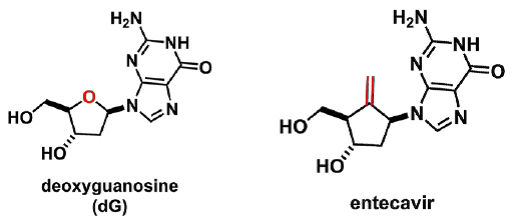
    Entecavir is a carbocyclic nucleoside analog that mimics the naturally-occurring nucleoside 2'-deoxyguanosine (dG):
    1

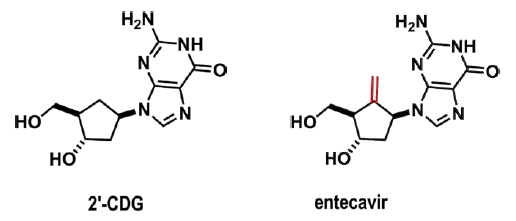
    Teva argued successfully that one of ordinary skill in the art seeking to make an anti-HBV compound at the time of the invention (1990) would have selected 2'-CDG, another prior art carbocyclic nucleoside analog, as a "lead compound" and would have modified 2'-CDG at the 5' position by adding an exocyclic methylene:
    2

    Judge Burke devoted 140 pages of his opinion to findings and conclusions that entecavir would have been obvious in light of the prior art.  The court held that "the prior art clearly would have directed the skilled artisan to select 2'-CDG, a carbocyclic analog, as a lead compound for further development efforts," finding that "in direct contrast to BMS's arguments in its briefing, the testimony of its own expert at trial repeatedly and conclusively established that researchers were, in fact, treating and using 2'-CDG as a lead compound in the relevant time period."  Similarly, in holding that a person of ordinary skill would have had a reason to modify 2'-CDG by adding a carbon atom at the 5' position, the court found "that the powerful admissions by BMS's expert severely undercut BMS's arguments to the contrary regarding motivation to combine."  The court likewise found BMS's arguments regarding reasonable expectation of success unpersuasive, stating, "notably, BMS's opening brief fails to address this factor of the prima facie case in any great detail."

    Before concluding that claim 8 of the '244 patent is invalid as obvious, the court examined the objective evidence of nonobviousness, observing that "all evidence relevant to obviousness or nonobviousness [must] be considered, and be considered collectively."  First, the court, "following the direction of the Federal Circuit and this Court's case law, [found] that Teva's choice to copy entecavir, while not irrelevant to the obviousness analysis, does not amount to compelling evidence of nonobviousness here."  Next, the court found "that Baraclude has been a commercial success, though a less dynamic one than BMS asserts in its briefs."  The court then analyzed the testimony of a BMS expert, Dr. Gish, relating to skepticism of those in the art, but found that "in the absence of additional corroborating evidence . . . [Dr. Gish's] verbal claim of skepticism is simply not enough to weigh in BMS's favor as to this factor regarding nonobviousness."  The court similarly found evidence of failure of others to be weak.

    The court ultimately concluded:

    Teva has made out a strong prima facie case of obviousness.  The evidence that it put forward at trial in that regard was multi-faceted and compelling.  In addition, as to almost every significant portion of the prima facie case, Teva's position was not only bolstered by the opinion of its expert, Dr. Heathcock, but also by the testimony of BMS's expert, Dr. Schneller.  On cross-examination, Dr. Schneller was forced to concede the accuracy of many significant points that Teva sought to assert as to that prima facie case.  The force of this evidence was clear, and it was convincing.

    As noted above, the evidence as to objective considerations was mixed.  Some of those considerations redounded to the benefit of BMS's position as to nonobviousness to a degree, but as to a number of other considerations, the impact of that evidence was not particularly compelling.  The totality of that evidence did not strongly persuade the Court as to entecavir's nonobviousness.

    In addition to obviousness, Teva argued that the '244 patent is unenforceable due to inequitable conduct.  Teva based its inequitable conduct allegation on the fact that prior art disclosing 2'-CDG was not cited to the PTO during prosecution (which, incidentally, strengthened Teva's obviousness position).  Here, the court sided with BMS, finding that Teva did not demonstrate "that the single most reasonable inference in this case is that [BMS] had the specific intent to deceive the PTO, nor that the evidence requires a finding of deceitful intent in light of all of the circumstances."

    Though successful in the district court, it is unclear when Teva will begin marketing its generic entecavir tablets, as Teva's ANDA has apparently not yet received tentative approval.  In addition, according to the Orange Book, BMS holds a three-year exclusivity on Baraclude that expires in October 2013 and another three-year exclusivity that expires in October 2015.  Meanwhile, BMS will very likely appeal today's decision to the Federal Circuit.

  •     by Aaron F. Barkoff

    Novo Nordisk recently became the fourth company to ask FDA for guidance concerning whether patents on pre-filled drug delivery devices should be listed in the Orange Book.  Novo markets several drug products as pre-filled pen-injector systems, including insulin and growth hormone products.

    In a Request for Advisory Opinion dated November 26, 2012, Novo raised two specific questions:

    1. What constitutes an approved pre-filled drug delivery system for purposes of determining whether information on patents relating to that system should be submitted to FDA for Orange Book listing; and
    2. Whether information on patents relating to approved pre-filled drug delivery systems should be submitted to FDA for Orange Book listing if such patents neither disclose nor claim the active ingredient or formulation of the approved drug product.

    Novo Nordisk's request follows similar requests submitted by GlaxoSmith Kline in 2005; AstraZeneca in 2006 and 2007; and Forest Laboratories in 2011.  According to Novo, "To date, FDA has not substantively answered the advisory opinion requests or otherwise publicly addressed the patent listing issues they raise."

    The Federal Food, Drug, and Cosmetic Act requires the sponsor of a New Drug Application to submit for listing in the Orange Book "any patent which claims the drug for which the applicant submitted the application or which claims a method of using such drug and with respect to which a claim of patent infringement could reasonably be asserted if a person not licensed by the owner engaged in the manufacture, use, or sale of the drug."

    Novo's request states that in June 2003, "FDA sought to clarify the types of patents that must and must not be submitted for listing in the Orange Book," and clarified "that if the patent claims the drug product as defined in 21 CFR 314.3, the patent must be submitted for listing."  The term "drug product" is defined by FDA as "a finished dosage form, for example, tablet, capsule, or solution, that contains a drug substance."  According to Novo:

    FDA stated that a key factor in determining whether to list a patent, therefore, is whether the patent claims the finished dosage form of the approved drug product.  FDA noted that these finished dosage forms include "metered aerosols, capsules, metered sprays, gels, and pre-filled drug delivery systems" but do not include "bottles or containers and other packaging."

    FDA's distinction between pre-filled drug delivery systems and product packaging remains unclear, however, because the term "pre-filled drug delivery system" is not defined.  The Orange Book does not list "pre-filled drug delivery systems" as a dosage form in Appendix C (Uniform Terms); nor does FDA's Data Standards Manual Dosage Form Monograph (C-DRG-00201) provide any useful guidance.

    Novo's request notes that in at least one instance a defendant in a Hatch-Waxman case filed a "delisting counterclaim" seeking the removal of a device-related patent.  That case, King Pharms. v. Intelliject (D. Del.), was dismissed before the court ruled on the counterclaim.  Novo argues that an advisory opinion from FDA addressing Novo's questions "could reduce the likelihood of patent delisting litigation and is in the interest of judicial economy."  Novo also argues that the "patent notice" and "early patent challenge" functions of the Hatch-Waxman Act would be advanced if FDA were to issue such an advisory opinion.

    Novo concludes its request by informing FDA–just as GSK, AstraZeneca, and Forest previously informed FDA–that in the absence of guidance from FDA that the listing of patents on pre-filled drug delivery devices is improper, Novo will submit such patents for listing in the Orange Book.

    RELATED READING:

  •     by Alex Menchaca

    I recently spoke at the Global IP
    Convention
    in Bangalore, India.  My presentation concerned lifecycle management strategies used by brand-name companies and some recent legal
    developments that may be helpful for generic companies responding to those strategies.

    While at the conference, I sat in on the excellent
    presentation of Mr. Caleb Gabriel.  He
    discussed various aspects of Indian law, including Section 3(d) of the Indian
    Patent Act, which is recognized as enacted to prevent "evergreening."  Section 3(d) of the Indian Patents Act states:

    3.  The following are not inventions within the meaning of this Act . . .

    (d) the mere discovery of a new form
    of a known substance which does not result in the enhancement of the known
    efficacy of that substance or the mere discovery of any new property or new use
    for a known substance or of the mere use of a known process, machine or
    apparatus unless such process results in a new product or employs at least one
    new reactant.

    Explanation: For the purposes of this
    clause, salts, esters, ethers, polymorphs, metabolites, pure form, particle
    size, isomers, mixtures of isomers, complexes, combinations and other
    derivatives of known substance shall be considered to be the same substance,
    unless they differ significantly in properties with regard to efficacy.

    The Indian Supreme Court is currently considering a Novartis
    challenge to the constitutionality of Section 3(d), but the consensus at the Global IP Convention was
    that the Supreme Court would uphold the
    provision.  Section 3(d) would likely
    prevent much of the patenting activity employed by brand-name companies in
    their strategy to maintain market dominance.

    I asked Mr. Caleb if he was aware of a similar provision
    being adopted in any other countries.  He
    advised that a similar provision has already been adopted in the Philippines
    and a number of other countries are in the process of adopting such a provision.  This is certainly something pharmaceutical companies should monitor in the months ahead.

    RELATED READING:

  •     by Christopher P. Singer

    On January 23, 2013,
    a group of major universities and technology transfer offices filed an
    amicus brief urging the United States
    Supreme Court to affirm the Federal Circuit in Monsanto v. Bowman.  The amici argued that reversing the Federal
    Circuit, which ruled that Bowman infringed Monsanto’s patents for Roundup
    Ready® soybean seeds, would have a substantial negative impact on university
    research directed toward artificial, progenitive technologies and the
    technology transfer function that is vital to bringing such technologies to
    market for the public benefit.

    In their brief, amici noted that "[i]n 2009, academic
    institutions performed over half (53%) of all basic research in the United
    States . . . and 14% of total U.S. research and development."  In particular, amici pointed out that research into artificial, progenitive
    technologies affects a wide range of areas like "stem cells, mutant genes, DNA
    vectors and molecules, viral vectors, bacterial strains, RNA enzymes, cell
    lines, and organic computers."  Much of
    their research is performed under the auspices of the Bayh-Dole Act, which
    allows universities to obtain patent protection for inventions developed with
    federal funding and then license those patents to help make the inventions
    accessible to the public.  Amici argued that reversing the Federal
    Circuit would harm the value of patents covering artificial, progenitive
    technologies, making it very difficult for universities and their technology
    transfer offices to license those patents for the purpose of making them
    available to the public.

    Amici also argued that when Bowman used harvested soybean seeds to grow
    further generations, he "made" new seeds that infringed Monsanto’s patents
    because "[e]ven authorized purchasers of a patented article cannot make 'a
    second creation of the patented entity.'"  Drawing on Supreme Court precedent, amici argued that "[u]nder any definition, Bowman certainly 'made' infringing seeds
    in this case, even though he grew them rather than genetically engineering them
    from starting materials."  Moreover, amici argued that this case did not
    present any unique concerns regarding "innocent infringement" that are not
    present in any other patent infringement case, and that in any event, Bowman
    was not an "innocent infringer" owing to his scheme to use illegally-purchased
    commodity seeds as "a cheap source of seed."

    Amici signing on to the brief included the Wisconsin Alumni Research
    Foundation, Association of University
    Technology Managers, Association of Public and Land-grant Universities,
    Association of American Universities, The Regents of the University of
    California, The Board of Trustees of the University of Illinois, University of
    Florida, Duke University, Emory University, University of Georgia Research
    Foundation, Inc., Iowa State University of Science and Technology, NDSU
    Research Foundation, University of Iowa, University of Missouri-Columbia, South
    Dakota State University, NUtech Ventures, University of Nebraska-Lincoln, University of Kentucky, University of Kansas, Kansas State University, Montana
    State University, and University of Delaware. 

    The brief was authored by Scott P. McBride, Stephen M.
    Wurth
    , and Caroline A. Teichner of McAndrews, Held, and Malloy, Ltd.

  •     by Alex Menchaca

    "Product hopping" is the practice of changing the
    formulation of an approved Reference Listed Drug to stay one step ahead of the
    generics seeking to compete with the RLD.

    In July, Mylan Pharmaceuticals filed an antitrust complaint accusing Warner Chilcott of engaging in product hopping in connection with its Doryx product, which is prescribed for the
    treatment of severe acne and other bacterial infections.  Other plaintiffs include Meijer and Rochester
    Drug Co-Operative.  The case is Mylan Pharms. et al. v. Waner Chilcott Co. et al., No. 12-cv-3824-PD (E.D. Pa.).

    The complaint alleges an interesting tale of how Warner
    Chilcott made a number of changes to its Doryx product in order to
    "manipulate the FDA regulatory processes to delay and/or prevent generic
    competition to Doryx, thereby foreclosing Mylan from the Relevant
    Markets."

    Warner Chilcott, the complaint alleges, first obtained
    FDA approval for a Doryx capsule.  When
    generic competitors were on the verge of attaining FDA approval for the capsule
    product, Warner Chilcott converted the marketplace from capsules to tablets.  This move, Mylan alleges, rendered its
    proposed generic version of the capsules obsolete as a capsule cannot serve as
    a substitute for a tablet RLD.  The
    complaint continues its tale reciting two more examples where Warner Chilcott
    "pulled the rug out from under the generics by switching the market" to new
    formulations.  As the generics neared FDA
    approval for a formulation, that imminent approval would be rendered
    obsolete.  This conduct, Mylan asserts,
    constitutes anti-competitive behavior in violation of the Sherman Act, 15
    U.S.C. §§ 1 and 2.

    Applesauce Study.  The complaint also explains how applesauce
    can be used as part of a greater plan to violate the Antitrust Laws:

    In
    2006, Defendants released a study for the administration of Doryx with
    applesauce and sought a corresponding labeling change that required generic
    manufacturers to develop tablets that could be administered by breaking the
    tablets into pieces and sprinkling the pieces over applesauce.  This scheme delayed Mylan's development of
    its generic Doryx tablets anywhere from 6 to 12 months.

    Motion to
    Dismiss. 
    Warner Chilcott filed a motion to dismiss commenting, in part, that the changes to its product were "nothing more
    than innovation [] and the marketing of those innovations once government
    approvals were obtained."  For example,
    Warner Chilcott reports that "dissolution storage stability" provided the
    motivation for one of the formulation changes.

    In its brief, Warner Chilcott argues that "[a]ntitrust law
    does not impose a duty on anyone to slow down innovation, roll out new products
    at a certain pace, keep older versions on the market, or do anything else to
    help competitors compete."  Warner
    Chilcott cites to two cases for the proposition that "competitive loss from
    alleged 'product switching' is not antitrust injury."

    Enter the FTC.  On November 21, 2012, the FTC filed a
    motion for leave to file an amicus brief.  In its amicus brief, the FTC
    asserts that "pharmaceutical product redesigns can constitute exclusionary
    conduct."  The FTC explains product
    hopping as follows:

    Product
    hopping can work in the following way:  first, the brand manufacturer makes
    minor non-therapeutic changes to the brand product, such as a dosage or form
    change.  Next, prior to generic entry, it
    removes the original product from the marketplace, or accomplishes this
    indirectly, such as by recalling supply of the original product or raising the
    price of the original product by a meaningful amount above the reformulated
    one.  Such conduct can push patients and
    physicians to abandon the original product. 
    In this way, a brand manufacturer can convert existing market demand for
    the original product to its reformulated product – not because physicians and
    patients prefer it, but simply because the original product is no longer as
    available or is more costly.  Once the
    original version of the brand product is less available or more expensive,
    physicians will stop writing prescriptions for it.  Because the prescription must contain, among
    other things, the same dosage and form as the generic for a pharmacist to
    substitute it for the brand, a product switch will effectively eliminate
    substitution at the pharmacy counter and thus meaningful generic
    competition.  As the author of the
    leading antitrust treatise put it:  "Product-hopping seems clearly to be an
    effort to game the rather intricate FDA rules . . . .  The patentee is making a product change with
    no technological benefit solely in order to delay competition."

    This past Monday, December 3rd, the court granted the FTC's motion and
    accepted its brief.

    Warner Chilcott reports that "[t]hree courts have considered claims that new
    pharmaceutical products constituted illegal 'product switching' in violation of
    the antitrust laws."  Two courts have
    dismissed the complaint and one permitted the case to proceed (this latter case
    reportedly settled for $250 million after one day of trial).

    We
    will keep our eyes on this case to see which way the court goes.

  • American Conference Institute will be holding its popular "Paragraph IV Disputes" conference in San Francisco next week, on December 4-5.  I will have the honor of speaking at the conference on a panel addressing "Paragraph IV Strategies for Method of Treatment Patents in View of Recent and Pending Decisions Regarding Inducement and Divided Infringement."

    The remainder of the conference agenda includes the following:

    • Anticipating and Reassessing Paragraph IV Challenges in the Era of the Patent Cliff
    • Analyzing Invalidity and Noninfringement Assertions in Light of the ANDA Applicant's Prelitigation Obligations and Assertions
    • Prior Art Obviousness and Obviousness-Type Double Patenting: Legal Analysis and Practical Applications for Brand Names and Generics
    • Labels, Patents and Use Codes: Understanding the Significance of Novo Nordisk v. Caraco to Hatch-Waxman Challenges
    • A View from the Bench–a panel featuring Judges Tonianne Bongiovanni, Garrett Brown, David Folsom, and Eugene Lynch
    • FTC Keynote: Pay-for-Delay Update
    • Settling Paragraph IV Disputes: Drafting and Negotiation Strategies for Brand Names and Generics
    • Exclusivities and Forfeitures: New Developments, Controversies and Concerns Relative to Paragraph IV Litigation
    • Controversies Surrounding Damages and At-risk Launches
    • Updating the Standards in Inequitable Conduct Post-Therasense: Ethical Considerations for Paragraph IV Cases

    In addition to the two-day main conference, two pre-conference workshops are offered on December 3rd: "Hatch-Waxman and BPCIA 101–a Primer on IP Basics and Regulatory Fundamentals" and "AIA/PTO Working Group: Assessing the Impact of New PTO Procedures Under the AIA on Paragraph IV Litigation."  There will also be a post-conference working group session: "Biosimilars: Product Development Strategies, Regulatory Review, and Anticipated Litigation Through a Hatch-Waxman Lens."

    Orange Book Blog readers are eligible for discounted registration by using code OBB 200.  For more information or to register, please visit the conference website.

  •     by George F. Wheeler

    The
    United States passed a radically new patent statute, the Leahy-Smith America
    Invents Act ("AIA"), on September 16, 2011.  The AIA has some provisions
    already in effect and others that will become effective in the near
    future.  This primer addresses the most important change of the AIA: The
    AIA will soon make patents more difficult to obtain and easier to defeat, in
    most instances.

    A brief summary of this effect of the AIA follows.

    1. EFFECTIVE DATE: The AIA
    will apply only to patent applications filed on or after March 16, 2013,
    regardless of when the resulting patents issue.  It won't substantially
    affect the patent applications on file before that date, for which the previous
    rules will apply.  By use of proper
    strategy, which is tricky, pre-AIA applications can be prosecuted for many
    years in the future and not ever be subject to the AIA.

    Note, however, that a dramatically different effective date
    rule applies to determine for which patent applications a patent interference
    can be filed, and some of the points made below do not apply to an interference situation.  Patent interferences already are very uncommon, and will
    not be important to most applicants.  But patent interferences will still
    be available under certain circumstances for many years in the future, before the
    AIA phases them out.

    2. CHANGE TO A 'FIRST-INVENTOR-TO-FILE" SYSTEM: Proof
    of when the inventors carried out experimental work or when they discovered
    their invention will have essentially no value for applications subject to the
    AIA.  Nor will such proof be useful to others to attack patents subject to
    the AIA.  In any contest between the first to invent and the first to file
    a patent application, the first to file will virtually always win, for
    applications and patents subject to the AIA.

    3. PARING BACK THE GRACE PERIOD: In the US
    before the AIA, the rule has been that once the invention is disclosed or
    commercialized by anyone (including a competitor or total stranger), the
    inventor has had one year to file a patent application to avoid losing all
    rights.  The one year period is called a "grace period."

    Under the AIA, this grace
    period will be an exception to the rule, not the rule.  The details of
    application of the new rule are complex, but the rule of thumb is simple.  The
    only truly safe way to conduct oneself as of March 16, 2013, is to follow the
    rule that Europe and many other countries have had for a long time: assume
    no grace period whatever, and get a patent application on file before the
    invention is first published, offered for sale, or revealed anywhere in the
    world, in any manner.

    4. EXPANDING ON THE SCOPE OF PRIOR ART: "Prior art" is all
    the information that legally existed before an application for the claimed
    invention was filed.  Prior art has an "effective date" (not to be
    confused with the effective date of the AIA).  Any information that is
    prior art can be used to show that an application or patent filed later is
    unpatentable or invalid.  The AIA expands what is prior art in several
    respects.

    • First, foreign public use or sale of the invention, which was never prior art before, will become prior art.
    • Second, the effective date of many Patent Cooperation Treaty (PCT) published patent applications as prior art will be earlier than
      before.  Under pre-AIA law, a PCT patent application published in a foreign language was
      prior art as of its publication date, and many English-language PCT patent applications were prior art as of the PCT filing date.  Under the AIA, many PCT patent applications will
      have as the prior art date the first day a corresponding patent application was
      filed anywhere in the world.
    • Third, a US patent application based on an earlier foreign patent application will have the
      earliest US or foreign filing date in the world as its effective date.

    These new rules can
    make the effective date of prior art patents and patent applications earlier by
    up to 18 months.  And again, you need to file an application before
    these new, earlier prior art dates, not just discover the invention first.

    5. HOW TO PREPARE FOR THE AIA: To
    gain pre-AIA treatment for your patent application, which will usually be more
    favorable, you need to file a patent application disclosing and claiming the
    invention as fully as possible and as soon as possible, but definitely before
    March 16, 2013–no extensions of that deadline will be available.  Plan
    ahead to avoid the rush, as everyone with an invention that wants to file a
    patent application will need to get their applications on file by the same
    deadline.  Moreover, nothing is gained by waiting until just before the
    deadline.  The purpose for filing
    this application is to avoid the more expansive AIA prior art rules, but also
    to obtain the earliest filing date possible. 
    Even under pre-AIA law, the first applicant to file usually wins in a
    contest with a later filer who invented first.

    There are a few niche
    areas in which the scope of prior art is reduced under the AIA, making it
    advantageous for a patent applicant to file a new or continuing application
    after March 16, 2013, to gain the benefit of the AIA.  But this will be a
    rare occurrence.  These rare occurrences can be dealt with by taking two
    steps:

    •  First, file a file
      a patent application as soon as possible claiming any invention that will
      benefit from post-AIA treatment.  Don't
      wait to do this until March 16, 2013, so your claims benefitting from post-AIA
      treatment will have an earlier effective filing date.
    • Second, on
      or after March 16, 2013, file a second patent application claiming priority to
      the first application and containing at least one claim NOT supported by the
      first application.  This unsupported
      claim does not need to be one of the ones that benefits from post-AIA treatment.

    By doing this, you will have claims with a pre-March 16, 2013,
    effective filing date that nonetheless benefit from post-AIA prior art rules–the best of both worlds.

    There are many other changes
    already here, or coming, due to the AIA.  Probably the most important of these
    are fundamental changes in how a US patent can be attacked in the U.S. Patent
    and Trademark Office.  The AIA provides
    post-grant review, a new procedure much like opposition proceedings in Europe.  The AIA also expands "prior user rights"
    enabling one who discovers and practices an invention commercially to continue
    practicing the invention even if someone else later independently discovers it
    and patents it.

    Note that
    this is a brief summary, and is not exactly applicable to every instance or
    situation, or everything you might ever need to know about the AIA.  But the above is in my view
    the core knowledge that every inventor and patent owner needs to possess in the
    near future to effectively deal with the AIA.

  • American Conference Institute will be holding its 13th annual "Maximizing Pharmaceutical Patent Life Cycles" conference in New York City on October 10-11.  There have many important developments in pharmaceutical patent law over the last year–from use codes to Myriad to the safe harbor–and this conference will bring you up to speed.

    The conference agenda includes the following talks:

    • From Product Development to Patent Portfolio Management:  Patent Life Cycle Strategies for a Post-AIA World
    • An Industry Perspective on Implementation of the AIA, New PTO Proceedings, and Their Collective Impact on Life Cycle Management
    • Preparing for the Implementation of the FDA's Biosimilars Pathway and its Effects on Life Cycle Planning
    • REMS Studies and Generic Entry:  Exploring the Latest Regulatory Conundrums Affecting Pharmaceutical Patent Life Cycle Strategies
    • Personalized Medicine and Patent Life Cycle Considerations in Light of Prometheus and Other Recent Challenges to Subject Matter Patentability, Written Description, and More
    • Employing Strategies to Avoid Findings of Obviousness:  Legal Analysis and Practical Applications for Brand Names and Generics
    • Inequitable Conduct Post-Therasense and How it Impacts Life Cycle Planning
    • USPTO Keynote:  The Brave New World of Patent Reform and its Impact on Pharmaceutical Patents
    • Understanding How Caraco has Redefined the Relationship Between Pharmaceutical Patents, Labels, and Use Codes
    • Analyzing Method Claims and the Madness Over Recent and Pending Inducement and Divided Infringement Cases
    • Exclusivities and Forfeitures:  New Developments, Controversies and Related Concerns
    • An Update on FDA Activities Impacting Pharmaceutical Patent Life Cycle Planning
    • Safe Harbor or Stormy Port?  Calming the Legal Tempest Left by Proveris
    • Understanding the Importance of Rx to OTC Switches to the Future of Pharmaceutical Patent Life Cycle Management

    In addition to the two-day main conference, ACI is offering two pre-conference workshops on October 9th:  Assessing the Impact of New PTO Procedures Under the AIA on Hatch-Waxman Strategies Relative to Patent Life Cycle Management; and Basic Training in the Essentials of Patent Term Adjustment and Patent Term Restoration for Patent Lawyers Serving the Biopharmaceutical Industry.

    Orange Book Blog is a media partner of the conference, so readers are eligible for a $200 discount by using registration code OBB 200.  For more information or to register, please visit the conference website.