• In Re: Cyclobenzaprine Hydrochloride Extended-Release Capsule Patent Litigation, No. 09-md-2118-SLR (D. Del. 2011)

    In an Opinion and Order issued today, the U.S. District Court for the District of Delaware found in favor of ANDA applicants Mylan, Barr and Anchen in the Amrix (Cyclobenzaprine HCl extended-release capsules) Paragraph IV litigation.  The decision follows a bench trial that took place last autumn.  The decision is somewhat surprising, because on April 8th, just before the 30-month stay was set to expire and while the parties were still waiting for an opinion from the court, the court enjoined the defendants from lauching generic versions of Amrix until the court issued its opinion.

    The patents-in-suit were U.S. Patent Nos. 7,387,793, which claims extended-release formulations of cyclobenzaprine HCl, and 7,544,372, which claims methods of relieving muscle spasms by administering the formulations.  The defendants argued that the asserted claims of the patents-in-suit are invalid for obviousness over prior art multiparticulate extended-release drug formulations, "when combined with the known PK parameters of immediate-release cyclobenzaprine as disclosed in the prior art."  The plaintiffs, Eurand, Cephalon and Anesta AG, argued that "before the patents-in-suit, no dosage form of cyclobenzaprine existed that provided a therapeutically effective plasma concentration over a period of 24 hours, nor did PK values for said formulation exist."  They further argued that not every element of the asserted claims was described in the prior art and, thus, the patents could not be obvious.

    The court, however, disagreed, noting that "not every limitation of a claimed invention need be found in the prior art," but instead gaps can be filled by the knowledge of a person of ordinary skill in the art.  Moreover, the court found that the claimed PK profile was disclosed in the prior art, "and optimization of this immediate release profile into an extended release form was routine for one of ordinary skill in the art."

    The court concluded:

    It would have been obvious to one of skill in the art at the time of the invention to try and create an extended release formulation of cyclobenzaprine mirroring the PK properties of the immediate release formulation.  If an extended release formulation matches the AUC and Cmax of the already approved immediate release formulation, a person of ordinary skill in the art can generally expect that the extended release formulation will have approximately the same effect in the body as the immediate release formulation.  Such a motivation is taught by the FDA, in its direction that an extended release dosage form should have the same AUC and Cmax of an already approved immediate release formulation.  Additionally, it would have been obvious to one of skill in the art to use the invention's claimed drug delivery system, as it had already proven effective with a drug that was related to cyclobenzaprine and shared many of its properties.

    Therefore, a person or ordinary skill in the art would have been motivated to take a group of known elements to create an extended release version of cyclobenzaprine, and to have a reasonable expectation of success in doing so.  The patents-in-suit "claim a structure already known in the art that is altered by the mere substitution of one element for another known in the field, and the combination did no more than yield a predictable result."  KSR.  Therefore, the invention was obvious.

    In addition to finding the asserted claims invalid for obviousness, the court found the claims not invalid for failure to comply with the best mode requirement; and found the patents not unenforceable due to inequitable conduct.  The court also found that Mylan and Barr infringe the claims, but Anchen does not.

    Mylan previously announced in a press release that it was the first to file a patent challenge relating to Amrix, and thus believes that it is entitled to 180-day exclusivity.  Mylan's ANDA was granted final approval on April 18th, following expiration of the 30-month stay.  It remains to be seen when Mylan will launch its generic Amrix product.

    RELATED READING:

  • In a press release today, the Federal Trade Commission announced that it "has notified Sanofi-Aventis U.S. LLC, Watson Pharmaceuticals, Inc., and Synthon Holding B.V., that it believes the companies violated federal law by failing to inform antitrust authorities about drug patent agreements involving Sanofi's insomnia drug Ambien CR."  According to the release, "the FTC staff told the companies that it decided not to recommend enforcement action for several reasons, including its finding that the violation does not appear to have harmed consumers or competition, nor benefitted the companies."  Instead, the FTC apparently decided this is a "teachable moment," and published advisory letters that it mailed to Sanofi, Watson and Synthon.

    The press release quotes FTC Bureau of Competition Director Richard Feinstein as stating, "The Bureau of Competition recognizes the importance of clear guidance concerning the types of agreements that are subject to the MMA filing requirement.  We expect that these companies, and the pharmaceutical industry more broadly, will closely consider the contents of these advisory letters in connection with future agreements that may be subject to the MMA."

    According to the advisory letters, Section 1112(a)(2) of the Medicare Modernization Act requires an agreement to be filed if it concerns:

    (A) the manufacture, marketing, or sale of the brand name drug that is the listed drug in the ANDA involved;

    (B) the manufacture, marketing, or sale of the generic drug for which the ANDA was submitted; or

    (C) the Hatch-Waxman 180-day exclusivity period as it applies to an ANDA based on the same brand name drug.

    In addition, "companies must also file the text or a written description of any agreements between them that are contingent upon, provide a contingent condition for, or are otherwise related to an agreement that is required to be filed under the provisions set forth above."  The letters further state that "the only exclusion from the Act's filing requirement is an exception for agreements that solely concern: (A) purchase orders for raw material supplies; (B) equipment and facility contracts; (C) employment or consulting contracts; or (D) packaging and labeling contracts."

    It appears that the FTC is monitoring activity in specific ANDA litigations–either in the press or perhaps through PACER–as the Ambien CR agreements were publicly available.  The FTC reminds industry that "in case of doubt about whether filing [of a specific agreement] is required, companies can contact Commission staff for guidance."

  • On Tuesday, the Federal Trade Commission released its report on Paragraph IV litigation settlements filed in Fiscal Year 2010 (Oct. 2009 through Sept. 2010).  The Medicare Prescription Drug, Improvement, and Modernization Act of 2003 (MMA) requires pharmaceutical companies to file certain agreements, including settlements of Paragraph IV litigation, with the FTC and Department of Justice.  Each year, the FTC releases a report on the settlement agreements filed in the previous fiscal year.

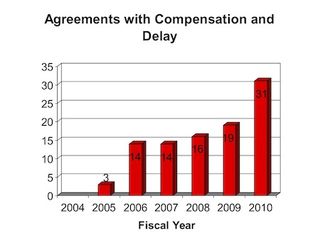
    The FTC's report for FY 2010 states that the FTC "received 113 final resolutions of patent disputes between a brand and a generic" during the year, 31 of which "contain both compensation to the generic manufacturer and a restriction on the generic manufacturer's ability to market its product."  The FTC refers to such agreements as "pay-for-delay" settlements.  In a press release announcing the report, the FTC noted that these 31 agreements represent a 60 percent increase in pay-for-delay settlements over FY 2009.  On a percentage basis, however, the number of such settlements remained the same in 2010 as it was in 2009.

    I returned yesterday from the ACI Paragraph IV Disputes conference in New York, where Michael Kades of the FTC gave a presentation on pay-for-delay settlements.  Mr. Kades noted that the increasing prevalence of such agreements since 2003,
    Graph when the 6th Circuit declared a pay-for-delay settlement to be illegal in In re Cardizem, corresponds with the approval of such agreements by the 11th Circuit in 2005 (FTC v. Schering-Plough); the 2nd Circuit in 2006 (In re Tamoxifen); and the Federal Circuit in 2008 (In re Ciprofloxacin).  Mr. Kades further indicated that the FTC continues to vigorously pursue antitrust cases against pay-for-delay settlements in other circuit courts, and hopes that ultimately the Supreme Court will resolve the issue or Congress will outlaw such settlements.

    RELATED READING:

  • Mylan Pharms. v. FDA and Ranbaxy Labs., No. 11-566-JEB (D.D.C. 2011)

    In an Opinion released earlier today, the U.S. District Court for the District of Columbia dismissed Mylan's lawsuit that sought to force FDA to act on Ranbaxy's ANDA for generic Lipitor (atorvastatin) and determine whether Ranbaxy forfeited its 180-day exclusivity for the product.  The court granted FDA's motion to dismiss for lack of subject matter jurisdiction and denied Mylan's motion for a preliminary injunction.

    In granting FDA's motion to dismiss, the court concluded that Mylan lacks standing to sue and that Mylan's claims are not ripe.  With respect to standing, the court found it important that Mylan does not have tentative approval of its own ANDA for atorvastatin, and therefore Mylan's injury is not imminent. In addition, according to the court, Mylan's task of establishing standing was made "substantially more difficult because they allege the FDA unlawfully delayed acting on Ranbaxy's ANDA rather than their own."  The court further found that Mylan's lack of tentative approval made its claims unripe, since they "rest upon contingent future events that may not occur as anticipated or may not occur at all."

    The court, however, left open the possibility that Mylan could refile its claims at a later date:

    By dismissing Plaintiffs' claims now, the Court does not foreclose the possibility that Plaintiffs may seek a judicial remedy at a future date — e.g., when Plaintiffs' claims are truly fit for review.  As the FDA points out, "Nothing prevents Mylan from seeking judicial recourse if and when FDA renders a final exclusivity decision that is not to Mylan's liking."

    Under the terms of a settlement with Pfizer, Ranbaxy will launch its generic Lipitor on November 30, 2011 (provided that its ANDA has been approved by then).  By filing this lawsuit, Mylan had sought to launch its own generic Lipitor as early as June 28, 2011.

    RELATED READING:

  • Over the weekend I read the new, third edition of "The Generic Challenge: Understanding Patents, FDA and Pharmaceutical Life-Cycle Management," by Martin A. Voet ($28.95 at Amazon).  Mr. Voet was formerly Senior Vice President and Chief Intellectual Property Counsel for Allergan.

    Like the first two editions, the book is short (162 pages), easy to read, and packed with information about patent law and FDA regulations relating to innovator and generic pharmaceuticals.  With the third edition, published earlier this year, the book has been updated to include discussions of the Biologics Price Competition and Innovation Act, which established a pathway for the approval of biosimilars; the pending patent reform legislation; and recent court decisions such as Novo Nordisk v. Caraco, concerning Patent Use Codes, and Ortho-McNeil v. Lupin, concerning patent term extensions.

    I highly recommend this book to anyone working in the legal, regulatory, business development and R&D groups at pharmaceutical companies–both innovator and generic.  Outside counsel working in this field will also find the book helpful, as it concisely ties together many disparate legal and regulatory considerations that are critically important to pharmaceutical companies.

    The Chapter list is as follows:

    1. Overview of Patents
    2. Patent Enforcement and Infringement
    3. Pharmaceutical, Biological and Medical Device Patents
    4. Overview of FDA
    5. Drug Product Exclusivity
    6. Hatch Waxman Act
    7. Putting it All Together: Product Life-Cycle Management
    8. Conclusions and Final Thoughts
  • The law firms of McAndrews, Held & Malloy and Dr. Volker Vossius will be co-hosting two complimentary patent law symposia next month–one in Chicago and the other in Munich.  CLE credit will be available.

    On May 3, 2011, the firms will sponsor a symposium in Munich, entitled "U.S. and European Patent Law Update for European Practitioners."  The symposium will be held at the Hotel Vier Jahreszeiten Kempinski, from 14:00 to 18:00, and will be followed by a cocktail reception.  The agenda includes:

    On May 19, 2011, the firms will sponsor a symposium in Chicago, entitled "Global Practical IP Perspectives."  The symposium will be held at the offices of McAndrews, Held & Malloy, from 8:00 a.m. to 4:30 p.m., and will include a complimentary lunch and cocktail reception.  The agenda includes:

    To attend, please RSVP to kanzlei@vovo.de (for Munich) or ksimoni@mcandrews-ip.com (for Chicago).

  • Mylan Pharms. and Matrix Labs. v. FDA, No. 11-566 (D.D.C.)

    Last month, Mylan filed suit against the FDA in the U.S. District Court for the District of Columbia, seeking a declaration that there is no applicable period of 180-day exclusivity for generic Lipitor (atorvastatin) that would block approval of Mylan's atorvastatin ANDA; and an injunction preventing FDA from withholding final approval of Mylan's ANDA on the basis of Ranbaxy's 180-day exclusivity.  Within days, Mylan filed a motion for preliminary injunction.  FDA and Ranbaxy (as Intervenor) then filed motions to dismiss Mylan's complaint.  Briefing on the motions was recently completed, and the briefs are available below.

    The crux of Mylan's suit is that "FDA has arbitrarily, unreasonably, and unlawfully failed to decide whether the Agency will enforce the terms of its Application Integrity Policy ("AIP") against the atorvastatin ANDA application submitted by Ranbaxy."  According to the Complaint, "FDA found that Ranbaxy engaged in a pattern and practice of submitting to FDA drug applications containing false and unreliable data generated from Ranbaxy's Paonta Sahib, India manufacturing site, where, Ranbaxy markets its generic LIPITOR."  Mylan contends that "if FDA enforces the AIP against Ranbaxy's ANDA, then the plain language of the FDA Act and the AIP require FDA to deny Ranbaxy's ANDA, and terminate any period of 180-day marketing exclusivity originally provided to Ranbaxy."

    According to Mylan, Ranbaxy cannot market generic Lipitor before November 2011 (due to a settlement with Pfizer), meaning that if Ranbaxy has 180-day exclusivity, other generic makers could not enter the market until May 2012.  But in the absence of Ranbaxy's 180-day exclusivity, Mylan could launch its generic Lipitor as early as June of this year.  Mylan further states that "upon market entry of generic LIPITOR, it is estimated that U.S. consumers, the government, and third party payors could save between $10.9 million and $18.6 million per day, which equates to between $3.97 billion and $6.8 billion in potential savings per year."

    FDA, in its motion to dismiss, responds that Mylan lacks standing, because it has not (yet) been injured; Mylan's claims are not ripe, because its own ANDA is not ready for approval; FDA's enforcement discretion is not subject to judicial review; and Mylan fails to state a claim for unreasonable delay under the Administrate Procedure Act.

    A hearing on the motions is scheduled for April 28th at 9:30 a.m.  The court should issue a decision shortly thereafter.

    Filings:

  • In re Tanaka, No. 2010-1262 (Fed. Cir. 2011)

        by Nabeela Rasheed

    Once a patent issues it behooves the patentee to scrutinize the claims to ensure that it has claimed all that it had a right to claim.  Where the patentee discovers that without deceptive intent the patent claims more or less than it should have, the patentee can seek a reissue patent under 35 U.S.C. §251.  In In re Tanaka, decided today, the Federal Circuit held that the simple omission from a patent of a dependent claim is sufficient reason to allow the patentee to seek reissue.  While today’s decision concerned a patent directed at an alternator pulley for improving an automobile alternator’s efficiency, it applies equally to pharmaceutical patents.

    In re Tanaka addressed an appeal from a decision of the Board of Patent Appeals and Interferences.  The Board had been asked to address the question of whether an examiner “erred in determining that the presentation of a narrower claim in a reissue application that still contains all of the original patent claims does not present the type of error correctible by reissue under 35 U.S.C. § 251.”  Procedurally, the Applicant initially had tried to broaden claim 1 with the reissue but during prosecution went back to the original scope of issued claim 1 while including in the reissue application a new claim dependent from original issued claim 1.  Thus, the only “error” the Applicant presented was the lack of presence of this dependent claim in the original issued patent.  The Board affirmed the Examiner’s decision by interpreting § 251 as not allowing a reissue where the sole correction in the reissue is the addition of a narrower dependent claim while retaining the original claims as issued.

    At the Court of Appeals, the PTO took the position that omission of a dependent claim does not make the patent “partially inoperative” because the subject matter of the dependent claim is covered by the independent parent claim.  Moreover, the PTO argued that omitting the dependent claim is not a case of “claiming more or less than the patentee had a right to claim in the patent.”

    The Federal Circuit disagreed, relying on Judge Rich’s opinion from In re Handel 312 F2d 943 (CCPA 1963), and concluded that “adding dependent claims as a hedge against possible invalidity of original claims is a proper reason for asking that a reissue be granted.” According to the majority opinion, hedging against the possible invalidity of the broader independent claims has been tacitly approved and is in accordance with the remedial purposes of the reissue statute.  Further, for the purposes of § 251 “inoperative” is construed as “inoperative adequately to protect the invention”  The Federal Circuit advises that contrary to the Board’s assertions, applying for a reissue that adds only narrower claims without amending any of the original claims is not the same as a “no defect” reissue.

    Thus, the Federal Circuit holds that omission of a narrower claim from a patent can render a patent partly inoperative by failing to protect the disclosed invention to the full extent allowed by law.  This case thus allows the applicant a second bite at the apple to pick up any additional dependent claims he/she may have forgotten along the way during prosecution.  Because the addition of a dependent claim is a “narrowing” amendment it is not subject to the 2 year broadening statute of limitations of the reissue statute and thus a reissue adding an omitted dependent claim could be filed at any time during the lifetime of the patent.

    Judge Dyk dissented – mostly reasoning that the precedent relied on by the majority did not address the issue of whether inclusion of a narrower claim is sufficient basis for a reissue.  Judge Dyk reasoned that some correction of an error affecting the original claims is required and in the present case the addition of the dependent claim had no impact on the applicants rights under the original patent.

    The case was remanded to the PTO.

  • American Conference Institute will be holding its 5th annual "Paragraph IV Disputes" conference in New York City on May 3rd and 4th at the Marriott New York Downtown.  This is a great conference if you're looking to keep up with the latest developments in Paragraph IV litigation.

    I will be speaking at the conference on May 3rd, on "Forfeiture of Exclusivity Dilemmas Relative to Paragraph IV Litigation."  The other talks include:

    • Pre-Suit Due Diligence Strategies:  Anticipating Paragraph IV Challenges to Small Molecule and Small Protein Patents
    • "Invalid or Will Not Be Infringed":  Re-Assessing the ANDA Applicant's Pre-Litigation Considerations and Obligations Under Paragraph IV vis-a-vis Microsoft v. i4i
    • New Standards and Controversies in Obviousness-Type Double Patenting:  Repercussions for Paragraph IV Challenges
    • Throwing Down the Gauntlet:  The Paragraph IV Notice Letter
    • Let the Games Begin:  The Start of the Paragraph IV Law Suit–Pleadings and Considerations
    • A View From the Bench on Paragraph IV Litigation (featuring Judges Garrett E. Brown, Joel A. Pisano, and Tonianne Bongiovanni, all from the District of New Jersey)
    • Mastering Regulatory Maneuvers essential to PIV Litigation
    • FTC Keynote:  Pay for Delay Settlements (by Markus H. Meier, Assistant Director at the Federal Trade Commission)
    • Damages and Injunctions:  Exploring the Consequences and Conundrums of Launching At Risk
    • Alleging and Defending Against Inequitable Conduct in a Paragraph IV Case:  Legal and Ethical Considerations
    • Discovery Strategies and Other Pre-trial Tactics for Brand Names and Generics

    In addition, ACI is offering a pre-conferencce workshop, "Hatch-Waxman and BPCIA 101," on May 2nd; and a post-conference workshop, "The Master Class on Settling Paragraph IV Disputes," on May 5th.

    For more information or to register, please visit the conference website.  Use discount code OBB to save $400 on registration fees.  I hope to see you there!
  • Dear Readers,

    I am happy to report that I recently joined McAndrews Held & Malloy, a large IP law firm in Chicago.  The left sidebar of the blog is updated with my new contact information.

    I will soon resume regular posting on Orange Book Blog, and I anticipate that some of my new colleagues will contribute posts as well.

    Thank you for continuing to read Orange Book Blog!

    Aaron Barkoff